
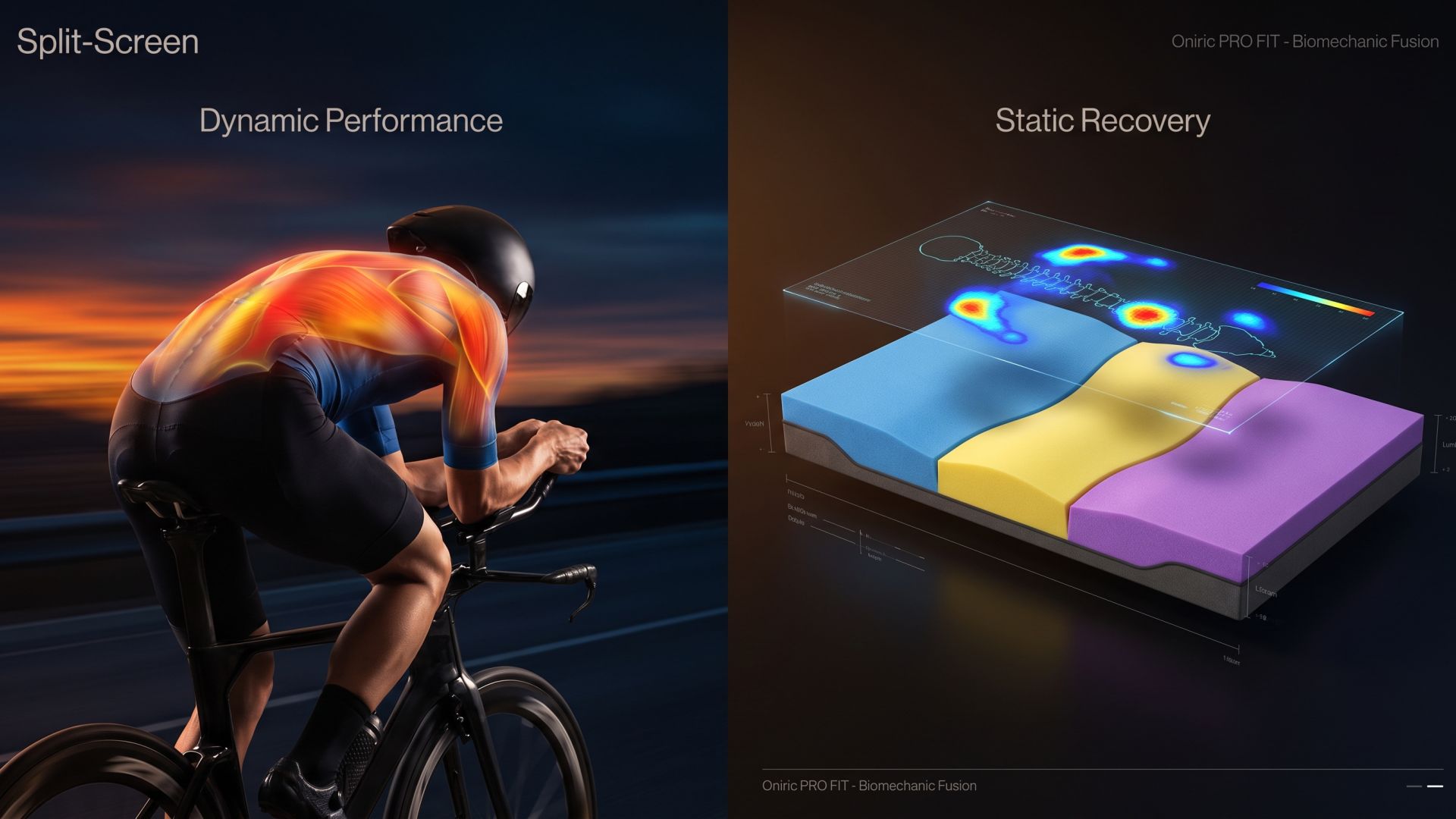
In contemporary sports science, we have moved beyond the traditional reductionist paradigm that analysed the athlete as a series of isolated systems. Today, we understand the human body as a complex, highly interconnected system in which training load, heart rate variability (HRV), the autonomic nervous system, nutrition and biomechanics interact within a continuous cycle of stress and adaptation [1, 2]. However, within this meticulous approach to performance planning, one critical blind spot often remains: the physical mechanics of nocturnal rest [7, 8].
Athletes invest significant resources in optimising their dynamic interaction with their equipment through bike fitting [3, 9]. Yet, once they get off the bike, they spend seven or eight hours lying on a generic sleep surface [8, 10]. From a biomechanical engineering perspective, nocturnal rest represents a critical mechanical phenomenon during which the body must recover from the loads accumulated throughout the day [11, 12].
The Body as an Integrated System: Sleep as a Catalyst for Hormonal and Tissue Recovery
During high-intensity training sessions, musculoskeletal tissues experience microdamage and accumulated fatigue, requiring structural and metabolic repair processes [12, 13]. At this point, the physiology of deep sleep provides one of the body's most powerful windows for regeneration [14, 15]. During delta sleep — or slow-wave sleep — approximately 75% of growth hormone (somatotropin) secretion occurs, playing a key role in protein synthesis, tissue repair and the clearance of metabolites such as lactate [12, 14].
However, this optimal physiological response depends on a critical factor: sleep quality and continuity [14, 16]. If the body is repeatedly forced into micro-arousals due to inefficient thermoregulation or discomfort caused by pressure peaks over prominent bony areas, sleep architecture becomes fragmented [14, 17]. As a result, slow-wave sleep may be reduced, narrowing the optimal window for hormonal release and potentially compromising the body's ability to assimilate the previous day's training load and recover effectively for subsequent training [14, 18].
Static Interaction: Maintaining the Spine in a Neutral Position
The human spine has natural physiological curvatures designed to absorb impact and distribute loads during standing and movement [19]. An endurance athlete — a cyclist, for example — subjects the spine to prolonged flexed positions and sustained fatigue of the paraspinal musculature [11, 12]. During sleep, the mattress should therefore act as an active orthopaedic support system capable of helping maintain these curvatures in their physiologically neutral alignment [11, 12].
Reference ergonomic literature, including research by Verhaert et al., indicates that an optimal mattress should redistribute interface pressure while simultaneously maintaining spinal alignment [4]. Conventional mattresses with essentially flat geometries may be limited in this respect, as they do not specifically account for differences in segmental body weight distribution or the individual anthropometric characteristics of the athlete [19, 20].
The human body is a complex, interconnected system: you cannot isolate training adaptation from the physical mechanics of your sleep [1]. Your performance does not begin when you get on the bike; it begins the night before, with the millimetre-level precision of your support surface [5, 6].
Auditable Science: Metrics from the Institute of Biomechanics of Valencia (IBV)
To move Oniric's proposition beyond perception-based marketing and provide it with scientific rigour, the ergonomic architecture of the Evolution core — the foundation of our Oniric PRO and PRO FIT systems — was experimentally tested using high-precision biomedical instrumentation in collaboration with the Institute of Biomechanics of Valencia (IBV) [21, 22]. The trials yielded empirical results that provide strong support for our biomechanical approach [23, 24]:
Spinal Alignment (p = 0.011): Using a high-precision inclinometric spinal measurement device applied to the spinous processes of the C7, T12 and L5 vertebral segments, the results showed with a statistical confidence level exceeding 98.9% that the lumbar support provided by the Oniric core brings the spine closer to its natural physiological neutral position, helping to prevent the paraspinal musculature from remaining under isometric tension throughout the night [25, 26].
Systematic Reduction in Interface Pressure (IBV Project PROY08/0006): Evaluated using XSensor® capacitive sensor mats with more than 6,000 measurement points, Oniric's ergonomic core demonstrated substantial reductions in the most critical pressure peaks [23, 24]:
Hips (lateral position): Maximum pressure decreased from 95.5 mmHg to 77.5 mmHg, relieving pressure around the hip joint and helping to minimise peripheral tissue ischaemia [27, 28].
Shoulders (lateral position): Pressure decreased from 70.8 mmHg to 60.2 mmHg, reducing the mechanical load on the shoulder girdle associated with the sustained riding position on the handlebars [27, 28].
Lumbar Region (supine position): Useful contact area increased from 311.3 cm² to 395.1 cm², providing active, balanced support for the lumbar lordosis [27, 28].
Personalisation Is Not an Option; It Is an Anthropometric Requirement
As demonstrated by Wong et al., individual anthropometric variables — including shoulder and pelvic morphology, body weight, height, BMI and habitual sleeping position — directly influence the support characteristics required during sleep [29]. The IBV report indicated that individuals with a higher Body Mass Index (BMI) showed a greater restoration of lumbar curvature when resting on a zoned ergonomic core compared with a conventional spring mattress [30, 31].
This is why Oniric's Sleep Fitting™ methodology always places assessment before recommendation [32, 33]. By analysing the athlete's self-reported variables through the Oniric Recovery Profile [2, 34], or by precisely mapping their load distribution through an in-person pressure mapping assessment using Tactilus technology — the Oniric Pressure Mapping Session [35, 36] — we can manufacture a dynamic, fully personalised sleep system designed to function as a genuine performance-support tool [37, 38].
For our partners and athletes, the principle is clear: training creates the stimulus; recovery enables adaptation [14, 39]. Optimising the biomechanics of your night can therefore become a meaningful component in creating the conditions for better recovery and subsequent performance [40, 41].
Scientific References
** Walsh NP et al.** Sleep and the Athlete: Narrative Review and 2021 Expert Consensus Recommendations. British Journal of Sports Medicine 42.
** Fullagar HHK et al.** Sleep and Athletic Performance. Sports Medicine 43.
** Verhaert V et al.** Ergonomic Evaluation of Mattress Systems. Applied Ergonomics 43.
** Radwan A et al.** The Effect of Mattress Design on Sleep Quality and Back Pain. Sleep Health 43.
** Wong DW et al.** Determinants of Mattress Evaluation. Ergonomics 43.
** Institute of Biomechanics of Valencia (IBV). Projects PROY08/0006 and PROY08/0627. Biomechanical evaluation of sleep systems through pressure analysis, anthropometry and spinal alignment [44].
Conversation
0 comments
There are no comments on this article yet.
To join the conversation, you need to sign in.